Come operano i memi nell'arte contemporanea — e cosa succede quando la rielaborazione memica diventa metamemetica?
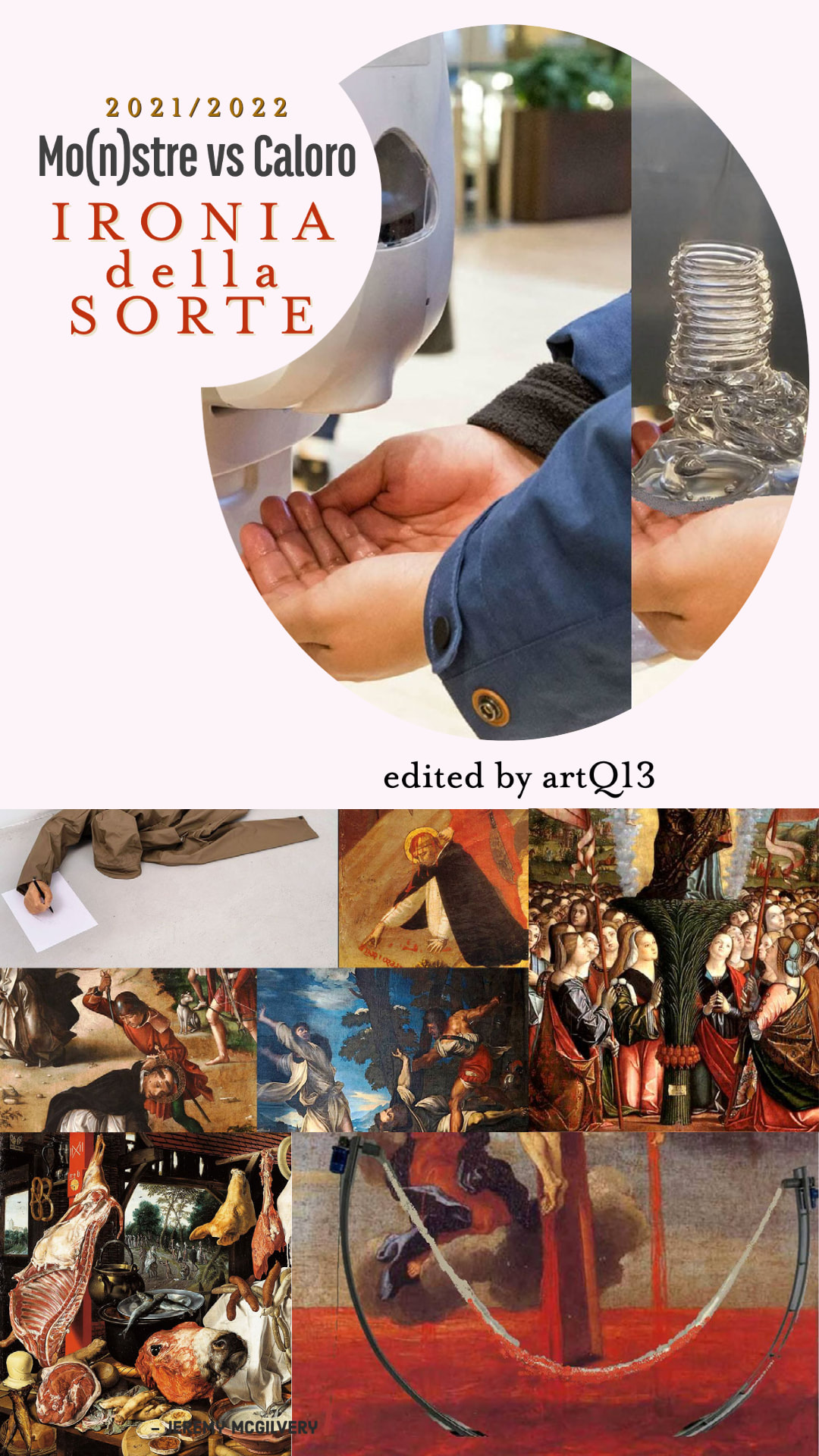
Progetto nato dalla collaborazione con Mo(n)stre, piattaforma di arti e discipline umanistiche. L’operazione compiuta da Mo(n)stre rappresenta “una vera e propria rielaborazione memica” dei lavori di Caloro, accompagnati da didascalie originali, note audio e accostamenti con opere del passato che generano “memi involutivi”.
Testo critico di Gabriele Perretta: “Non solo intenzional.mente” — riflessione sul ruolo dell’artista nell’era post-industriale e dell’intelligenza artificiale.
Extended archive content is available for this project.
Il progetto
Il progetto Ironia della Sorte nasce dalla collaborazione con Mo(n)stre, piattaforma di arti e discipline umanistiche. L’operazione compiuta da Mo(n)stre rappresenta una vera e propria rielaborazione memica dei lavori di Carlo Caloro, accompagnati da didascalie originali, note audio e accostamenti con opere del passato che generano “memi involutivi” — un processo metamemetico che rivisita il concetto di meme teorizzato da Richard Dawkins.
Testo critico — Gabriele Perretta: “Carlo Caloro: Non solo intenzional.mente”
Riflessione sul ruolo dell’artista nell’era post-industriale e dell’intelligenza artificiale. Il saggio analizza il rapporto tra produzione artistica e gig economy, la rivoluzione digitale e il ruolo dei memi nell’arte contemporanea. Perretta esplora come il lavoro di Caloro si posizioni all’intersezione tra medialismo e meta-memetica, interrogando le dinamiche di produzione e ricezione dell’opera nell’epoca della rete.
English — “Carlo Caloro: Not only intentional.ly” by Gabriele Perretta
What is the true nature of the artistic deception that we live through, or “pro-create”? Particularly in those areas where so much abstractness abounds? We are now in the post-industrial era in which machines perform — and will increasingly perform — almost all practical and repetitive activities. The only prerogative left to human beings is creativity, robots permitting.
We must juggle between our direct perception of technological change — where we might discover opportunities to improve our lives — and the dystopian vision present in the artistic outcry of the traditional media and its “artisans”, who after years of dominating our free time now feel “replaced”. Digital media is increasingly visual because it is easier to capture attention with fast and self-saturating codes.
The role of the artist has completely changed, having found themselves as workers in a vast creative ‘pantry’. While many are quick to define the present as the outcome of an accomplished revolution, the so-called “digital revolution”, we are really at the beginning, in a sort of “antiquity” in which the problems we see are actually not caused by the internet, but simply revealed by the misinterpreted determinism of the new media.
From this perspective, the work of Carlo Caloro, accompanied by Fabrizio Federici, Irony of Fate, can also be the inspiration which gives rise to artistic enterprises capable of reconciling the economy of the meme with the strategy of the assemblage, the aesthetics of the Renaissance with the ethics of the New Middle Ages. Like all the artists of the complex image, Caloro likes to play with images, concepts and objects of his own and of others, connecting them, overturning them, making them ambiguous, proposing them with other structures, with other meanings. Carlo Caloro’s mimetic sequences acquire meaning from the contexts that surround them.
Carlo Caloro is a tireless researcher, who knows that any element in context can prove to be the missing link in an interpretative chain, digital and yet real. For Caloro, everything counts and everything sings! Supported by Federici, Carlo Caloro’s ‘crossings over’ help us to re-envisage History, to revisit and re-analyze the artistic world populated by whole chapters of iconography and iconology.